Grand County has a rich water history and some of the most interesting water attractions in the state. These attractions have helped to shape the growth and development of Colorado and the Front Range.
Alva B. Adams Tunnel
- Part of the Colorado Big Thompson Project
- Tunnel named for US senator from Colorado who played a large role in convincing Congress to fund and construct the Colorado Big Thompson Project.
- Construction began on June 23, 1940 southwest of Estes Park. Work started simultaneously from both sides.
- Crews spent four years, 1940-1944, drilling the tunnel. Work stopped twice due to demands during WWII.
- The two crews meet in the middle on June 10, 1944 and were only off by less than the width of a penny.
- The next three years, 1944 – 1947, the tunnel was lined with concrete and readied for water delivery.
- Water from the Colorado River first flowed east through the tunnel on June 23, 1947.
- The tunnel is 13.1 miles long and flows under Rocky Mountain National Park and Continental Divide, and the construction of the tunnel cost 12.8 million dollars.
- Adams tunnel is the longest tunnel in the US to provide water for irrigation.
- 213,000 acre-feet of water are delivered annually thru Alva B. Adams Tunnel.
- Alva B. Adams Tunnel delivers up to 1,100 acre feet of water in 24 hours.
- The tunnel is maintained by the US Bureau of Reclamation and is inspected once a year.
Colorado Big Thompson Project
- Largest trans-mountain water diversion project in Colorado
- Built between 1938-1957
- Provides water to 30 cities and town, used to irrigate 693,000 acres of northeastern Colorado farmland
- Made of 12 reservoirs, 35 tunnels, 95 miles of canals, and 700 miles of transmission lines
- Spans 150 miles east to west and 65 miles north to south
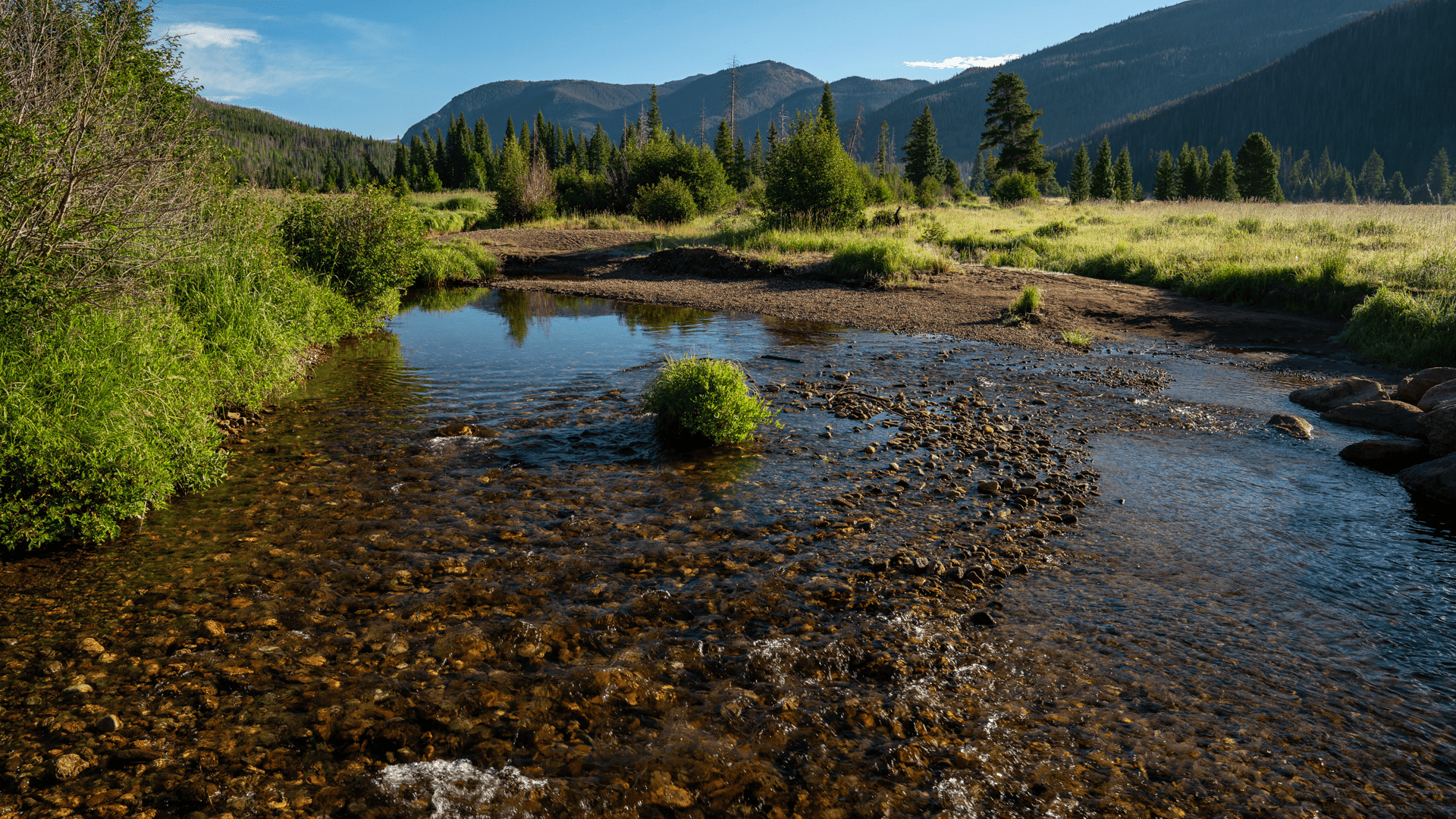
- West of the Continental Divide, water collects from the upper Colorado River in Willow Creek Reservoir, Shadow Mountain Reservoir, Grand Lake, and Lake Granby (all in Grand County, the start of the Colorado Big Thompson Project). Water is pumped into Shadow Mountain Reservoir where it flows into Grand Lake.
- From there, the Alva B. Adams Tunnels water under the Continental Divide to the eastern slope.
- Once water reaches the eastern slope, its used to generate energy as it falls almost half a mile through five power plants on its way to Colorado’s front range.
- Carter Lake, Horsetooth Reservoir, and Boulder Reservoir store the water delivered to the Front Range by the Colorado Big Thompson Project.
- Water is released as needed to supplement water supplies in the South Platte River Basin.
- The Colorado Big Thompson Project annually delivers 213,00 acre-feet of water to northeast Colorado for agriculture, municipal and industrial use. (all info taken from Northern Colorado Water Conservancy District)
Berthoud Ditch
- Built in 1910 owned by the cities of Northglenn and Golden
- Water diversion project to a tunnel that goes underneath Berthoud Pass
- Flows to Hoop Creek in the Clear Creek watershed to Standley Lake in Westminister
Denver Water Background
- Denver Water serves about a quarter of the state’s population but uses less than two percent of all water, treated and untreated, in Colorado.
- Denver Water is a separate entity from the city of Denver, with nearly 50 percent of its customers living in the surrounding suburbs (water service contracts) of the City and County of Denver.
- The majority of Denver’s water comes from rivers and streams fed by mountain snowmelt. The South Platte River, Blue River, Williams Fork River and Fraser River watersheds are Denver Water’s primary water sources, but it also uses water from the South Boulder Creek, Ralston Creek and Bear Creek watersheds.
- Denver Water is Colorado’s oldest and largest water utility.
- Denver Water is a leader in water conservation, and its customers have demonstrated commitment to water efficiency with per capita use down 36% since 2000.
Moffat Tunnel Basics
- The 6.2-mile Moffat Tunnel carries water collected from 36 Grand County streams, under the Continental Divide, and down South Boulder Creek.
- Water is either stored in Gross Reservoir or sent to Ralston Reservoir and the Northwater Treatment Plant for treatment and distribution to water users in the Denver metro area.
- The tunnel can deliver up to 100,000 acre-feet of water a year, providing an important source of water for Denver Water customers.
- Water first flowed through the tunnel in June of 1936. It was enlarged after the drought of 1950 and lining was completed in 1958. After leasing it from the federal government for about 30 years, Denver Water purchased the tunnel in 1996 to safeguard water supplies in the north system for future generations.
- The ‘water’ Moffat Tunnel runs parallel to and separate from the ‘train’ Moffat Tunnel. The ‘water’ tunnel was the pilot bore for the ‘train’ tunnel and was also used for worker access for building the train tunnel. After the ‘train’ tunnel was in service, the ‘water’ tunnel was repurposed as a transbasin diversion.
Enviornmental Note of Interest
- As part of the process to secure approval to expand Gross Reservoir, Denver Water committed to numerous environmental improvement projects on the West Slope.
- Among them was the conveyance of 539 acres of the Toll Property, located near the east portal of the Moffat Tunnel in Gilpin County, to the Forest Service as open space for protection as part of the National Forest System.
- This remote area is an ecological gem, and the property provides expansive undeveloped forested habitat for wildlife and supports unique wetland types and mature riparian plant communities.
- This property conveyance will provide additional protection for lands near two wilderness areas (India Peaks and James Peak) and the Arapaho National Forest, and complements a larger landscape protection effort led by The Conservation Fund.
Links with more information
Links with more information: